 Jon Jack
The pattern across our 100,000+ client engagements is consistent. Owners who fully commit to modern AI infrastructure eliminate 80%+ of repetitive human labor and generate 2-3X return on investment within the first year of implementation. The owners who don’t stay stuck on the same 10 problems year after year.
There’s one truth underneath every bottleneck on this list. AI is garbage in, garbage out. Without solid systems and infrastructure, AI cannot save a business. It amplifies whatever is already there, including the chaos. The owners who break out built the foundation first. The ones who didn’t are watching their competitors pull away in real time.
No business stays stagnant. By the law of diminishing returns, a company that isn’t compounding is deteriorating, even when revenue looks flat. In 2026, with AI rewriting how every industry operates, standing still is the fastest way to fall behind.
1. How do I make more money with fewer employees?
You make more money with fewer employees by replacing repetitive human labor with AI infrastructure that operates continuously and redeploying remaining staff to revenue-producing work. Across our 100,000+ client engagements, owners who fully commit to this approach eliminate 80%+ of repetitive labor and see 2-3X ROI within the first year.
The owners we work with who scaled revenue without scaling payroll mapped every recurring task in their business, separated the human-required work from the system-replaceable work, and automated the second category first. The question used to be how do we make our teams more efficient. The question now is how do we build infrastructure that operates around the clock so waste cannot exist. Adding headcount is the slowest, most expensive way to grow a small business in 2026.
2. Where do I start with business automation as a beginner?
You start with systems and infrastructure, because AI is garbage in, garbage out. Without a solid foundation, automation amplifies whatever process you already have, including the broken ones. The starting point hasn’t changed in 20 years. What changed is the leverage.
When systems still required teams of humans to operate, the math justified slow implementation. In 2026, modern AI infrastructure can replace 80%+ of the human layer and still deliver multi-X returns. The owners who try to fix 20 years of chaos in 20 days fail every time. If you’ve been aware of a problem for 20 years, you cannot fix it in 20 days, and you cannot automate your way out of it without a partner who builds the foundation first. The ones who let that foundation get built see returns in months.
3. How do I reduce labor costs without cutting people?
You reduce labor costs by eliminating wasted hours instead of cutting headcount, which is the difference between cost reduction that destroys capacity and cost reduction that compounds it. Federal Reserve research found generative AI saves workers an average of 5.4% of work hours, with frequent users reclaiming 9 or more hours per week.
The clients who saw the biggest labor cost wins did not lay anyone off. They installed infrastructure that handled the lead intake, follow-up, scheduling, and basic customer questions that were eating their team’s day. The team they already had became significantly more productive because they stopped doing work a system should have been doing. With these systems in place, not a minute is lost. That recovered time is what we redirect into revenue-producing activity, which is how the same team starts producing more without the payroll line moving.
4. What does AI for small business actually look like in 2026?
AI for small business in 2026 is a 24/7 operations layer that handles lead capture, qualification, follow-up, scheduling, customer questions, and internal task routing without human intervention. According to the U.S. Small Business Administration, 83% of growing small businesses have adopted AI compared to just 55% of declining businesses.
The small businesses winning right now are not using AI to write social posts. They are using AI as infrastructure that captures every lead, runs every follow-up, and protects every dollar of revenue from leaking out overnight. The shift from AI as a novelty to AI as infrastructure happened quietly over the last 18 months. Most owners are still in the novelty phase, asking what tool they should buy. The owners pulling ahead are asking which parts of their business currently require them to be awake, and how to make those parts run whether they are there or not.
5. What’s a real small business AI roadmap in 2026?
A real AI roadmap for a small business in 2026 starts with foundational systems before software, fixes the lead and follow-up layer first, and only then expands into operations, sales, and back-office. Most roadmaps online are tool lists. A tool list is not a roadmap.
The order matters because every layer you automate sits on top of the last one. If your lead capture is broken, automating your sales follow-up just routes broken leads faster. The order is foundational systems first, then revenue-protection automation, then operational automation, then sales and marketing automation, then analytics. Skipping the order is the single biggest reason small business AI projects fail. Every implementation we’ve measured across 100,000+ engagements that skipped the order produced disappointing results regardless of how much was spent.
6. How do I stop working 80 hours a week in my own business?
You stop working 80 hours a week by replacing yourself in the daily operations of the business through documented systems and AI infrastructure, not by managing your time better. Time management is the wrong frame. The real problem is that the business cannot run without you in the room.
People pay to be a boss. They believe owning a business means having their hands on every page. The owners who hit real freedom built complete systems and removed themselves from the daily operating cadence so they could focus only on high-level decisions. Some removed themselves entirely. Realtors are especially guilty of this trap. They produce great results but stay constantly behind on the next opportunity because they are personally involved in every transaction. Time is the one resource you cannot scale by working harder.
7. Why is my business a bottleneck and how do I fix it?
Your business is a bottleneck because every decision, sale, and operational step routes through you, which caps the entire company at the speed of one person. The fix is not delegation. The fix is replacing yourself with infrastructure in defined zones of the business so the work runs without your input.
The owners who break this pattern thrive because their companies don’t run off chaos. The ones who don’t break it stay stagnant, and some actively create new problems in the business because chaos is the environment they know how to operate in. Those are the clients we don’t take. We only work with owners ready to step out of the way. If you are the bottleneck and you’re not ready to move, no system will save you. AI built on top of an owner who refuses to step back is garbage in, garbage out at the leadership level.
8. How do I automate lead follow up?
You automate lead follow-up with AI infrastructure that responds within seconds of a lead arriving, qualifies them automatically, and runs a multi-channel sequence until they book or opt out. Industry research shows 79% of marketing leads never convert into sales, most due to poor qualification or nonexistent nurturing. The clients we work with who never miss a call, text, or web form increased conversion rates by 20% from where they started.
That is not a marketing improvement. That is an infrastructure improvement. Most businesses lose leads not because the leads were bad but because the response was slow. The fix is not better salespeople. The fix is a system that runs whether the team is asleep, on vacation, or already on another call. Speed is the variable that determines everything.
9. How do I tell if a lead is a waste of time?
You tell a lead is a waste of time by qualifying for budget, authority, urgency, and fit at the first point of contact, before a salesperson ever spends time on a call. The fix is a qualification system that runs before a human ever picks up the phone.
A qualified lead has already done the work before they reach you. They know what they need, they have authority to buy, and they have urgency to move. Tire kickers don’t have any of those three. If your intake doesn’t separate the qualified from the unqualified, every salesperson on your team is bleeding hours into prospects who were never going to buy. The clients we work with who installed real qualification at the front of their pipeline cut their wasted sales hours dramatically and redirected that time into closing the leads who were actually ready.
10. What’s the best AI answering service that actually books jobs?
The best AI answering service captures the lead, qualifies them in real time, books the appointment directly into your calendar, and confirms it back to the customer without a human ever touching the conversation. A message-taking service is a 1995 solution to a 2026 problem. The standard now is full booking.
The clients running this layer have eliminated the gap between inbound interest and confirmed appointment, which is where almost every small business loses revenue overnight, on weekends, and during peak hours when the phones are tied up. The conversion lift we measure on this single change averages 20%. That’s not because the leads got better. It’s because the leads stopped falling through the cracks between when they called and when someone called them back.
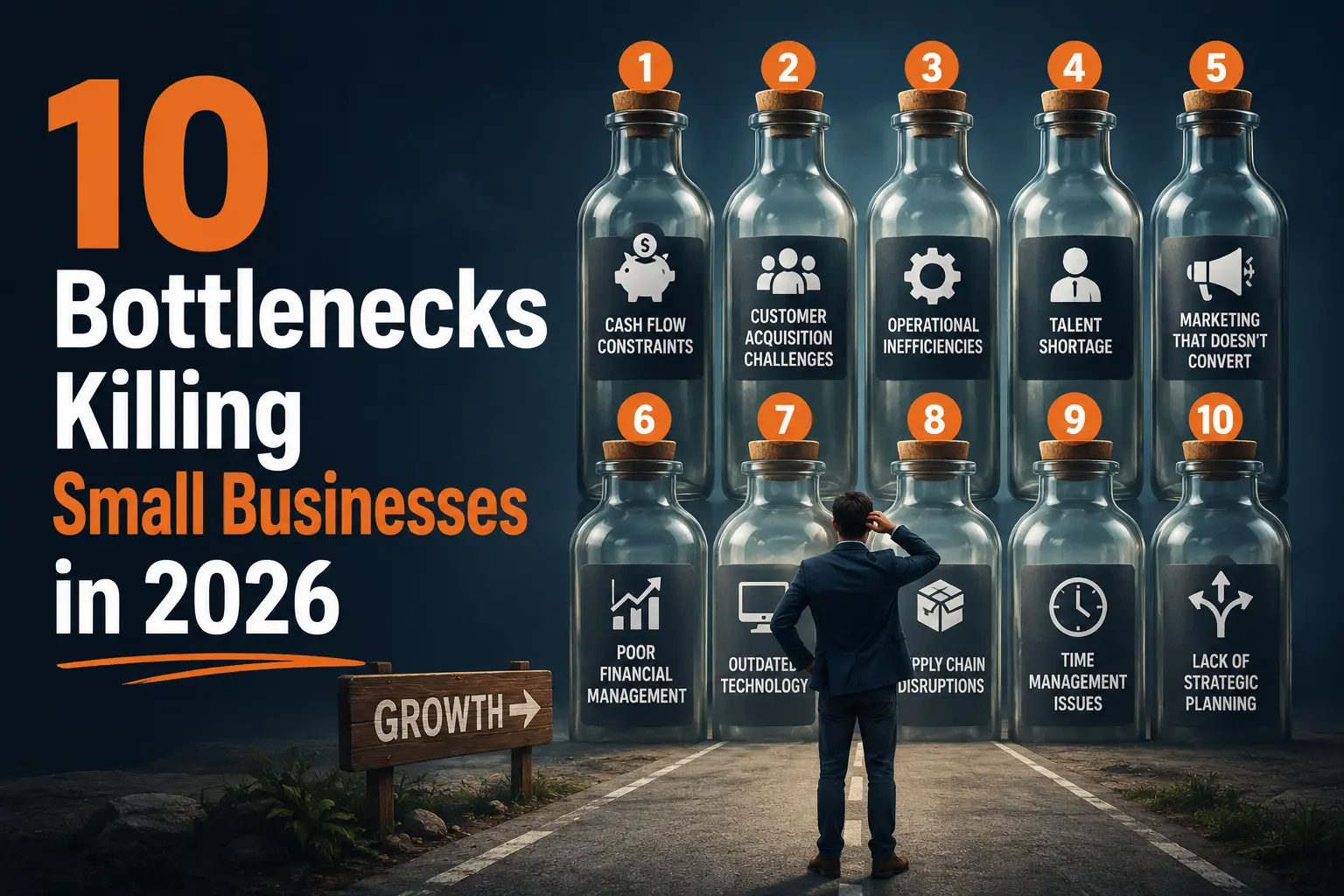
Every bottleneck on this list traces back to the same truth. AI is garbage in, garbage out. Owners stuck on these problems are trying to layer AI on top of broken infrastructure, and they’re getting exactly what the math predicts. Owners who break through built the foundation first, then layered AI on top, and saw 80%+ elimination of repetitive labor with 2-3X ROI within a year.
Most agencies build custom one-off solutions that don’t think past the individual problem. Overtime Global operates at the enterprise level and brings that thinking down to a size that small and mid-market businesses can use through Overtime GO. We work with owners ready to step out of the way and build something that compounds. We don’t work with owners who want to fix 20 years of chaos in 20 days, because no system can save someone who refuses to move. No business stays where it is. It either compounds or it deteriorates. The only question is which direction yours is moving in right now.